HayU Blog

Anger: A Conversation with Dr. Karen Fried
August 14th, 2026


Tingling in your body. Rapid heart rate. Tense muscles. Stomach tightening into knots. Blood rushing to the head. These are all manifestations of anger in our body. Why is anger such a taboo emotion for many?

I recently sat down with our dear colleague Dr. Karen Fried to discuss anger. I started with why it’s so difficult for many people to tolerate and/or accept anger. Karen shared, “My mentor Dr. Violet Oaklander wrote in her article The Many Faces of Anger that anger is the most misunderstood and least tolerated emotion. Through my work in the US and in over 50 countries, my colleagues and students agree that in most of these cultures and countries, anger is discouraged, especially in children, where among other things, it is viewed as disrespectful and unacceptable. The only exception I’ve found so far is in my workshops with therapists in countries that have experienced continued trauma inflicted by war. They explain that after so many generations of war, they accept the expression of anger in their children and see the value of angry feelings and expressing aggressive energy. For them, it’s more fear that is the taboo emotion, since it’s not seen as helpful to their circumstances.”
It’s so interesting that the expression of anger is almost universally discouraged in children around the world. We continue to repress anger into adulthood and repeat the cycle in the next generation.
So what is actually happening in our bodies when we feel anger? Karen shared, “We find that it’s different for every individual. The Oaklander Model teaches us that the triggers and sensations of anger are unique to them. In the body, some people feel anger in their chest, others in their stomach, some describe it as tingling, others as a rush. Some feel anger as a restriction or the cutting off, some lose their voice, tense up, or even freeze. Some people may use different words to describe this feeling. A child might use words such as sad, scared, or annoyed, and adults might avoid the word 'anger' and try to reframe the emotion as frustration. In discussing our 'Window of Tolerance,' Dr. Dan Siegel explains that anger can be the result of dysregulation and a sign of a narrow or small amount of tolerance to the environmental stimuli around us. It can be, according to the Oaklander Model, that acknowledging and expressing our strong emotions, such as anger, can be empowering, and can allow someone to feel more regulated.”
Does anger show up differently for children and teens with anxiety? “Anger expressed in the safety of the therapeutic environment can be a relief for anxious children. Often, according to Dr. Oaklander, the messages children receive that anger is unacceptable results in children repressing strong emotions such as anger. When provided with appropriate and safe ways to express their feelings, children and teens often feel calmer once they can acknowledge and express their anger, especially in aggressive physical expression of the body (i.e. destroying something like a magazine, jumping and stomping, tearing paper, hitting something like clay),” Karen shared.
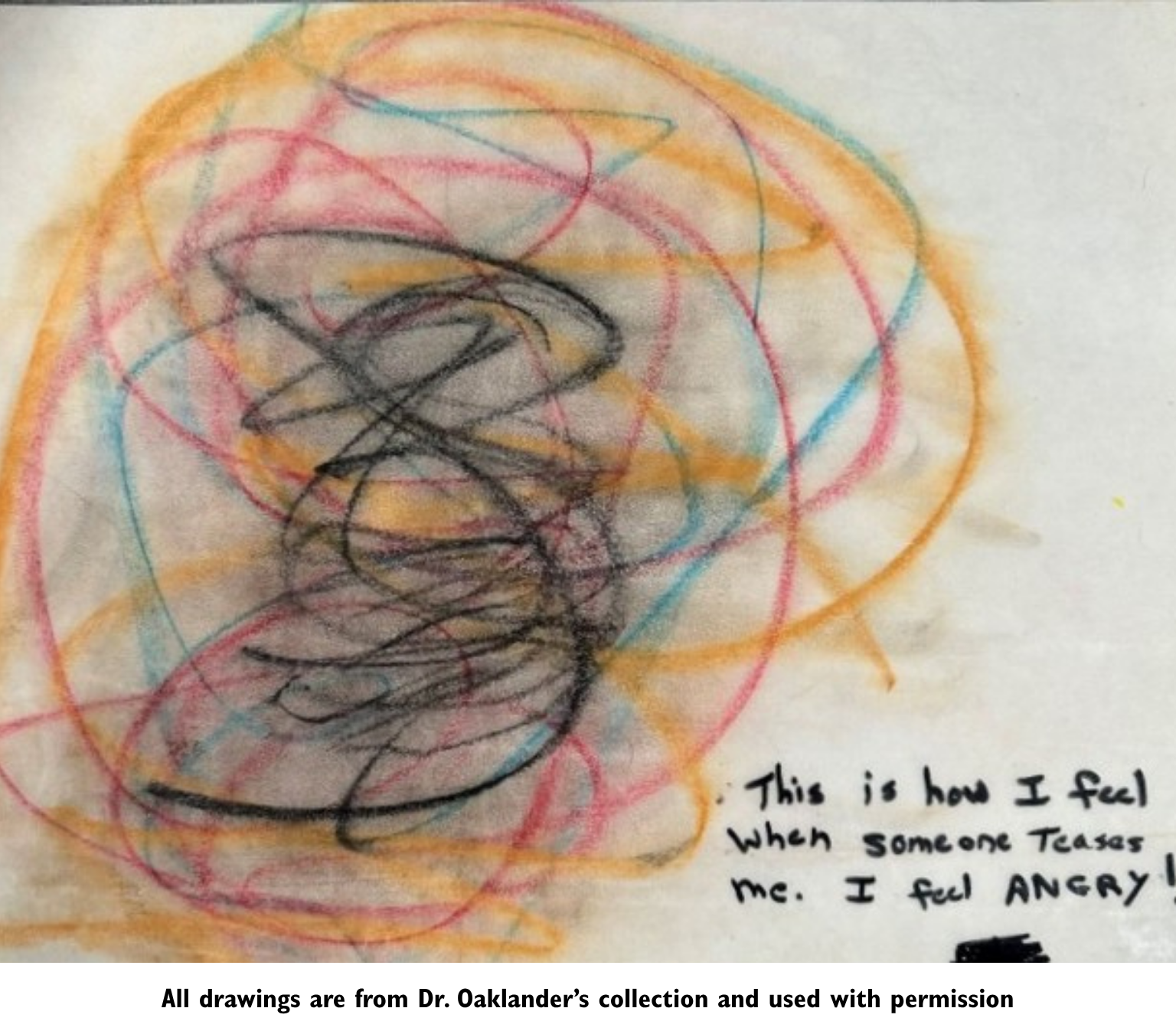
When children and adults don’t express their anger, they turn inward in a process called retroflection. Unfortunately, the anger doesn’t just disappear, and suppressing the emotion in our body can cause physical symptoms like stomachaches, headaches, etc. Finding a safe outlet to express anger is ideal.
Karen shared several ways to express anger, and a few of our favorites for children include:
- Acknowledge the feeling: “I am angry” or “I feel angry”
- Physical Release: Allow kids to be loud and physical in a crash space, hit pillows, stomp their feet, rip up paper, wash their face with cool water, etc. Kids need to let the aggression out before transitioning to a calm state, and they need adult support to do so. We can help the child go from an activated state to a place of metacognition, another way of saying they can be aware of their own process. Stay with the child to help them co-regulate and feel safe.
- The Gripe List: Invite your child to complain about anything that is on their mind and write it down for them. I tried this with my 7 year old daughter, and it was a wonderful outlet for her. Most of her complaints were about her little brother.
- Kintsugi: A Japanese art that repairs broken objects with gold, creating a new piece that is beautiful and highlights the repair rather than trying to hide it.
- Also available in Karen’s virtual tool Mindful Repair
- Karen has developed several virtual tools that therapists use in their virtual play therapy sessions. These are available for anyone to use for free.
Some parental anger can be scary to children and have lasting effects. Being around anger that feels unsafe to children might persist into adulthood. However, repair is possible when parents acknowledge and address these issues.
Karen suggests taking a curious approach while being ready for an authentic response. “What was that like for you?” Hearing your child, truly considering their perspective, apologizing if appropriate, and reflecting upon any triggers that elicited your anger can be helpful. If adults can get more comfortable with their own anger, it can free the whole family to express anger in healthy ways. Parents often deny their own anger, because of the messages we all receive that anger isn’t acceptable. When anger and feelings associated with anger are acknowledged, parents can start modeling, rather than suppressing and/or venting, healthy anger for their children.
How do you sense anger in your own body? How does your family handle anger? Check out the resources below.
Dr. Karen Fried is available for consultations, trainings, and workshops for therapists and schools.
- Virtual Play Therapy Apps
- Books (Karen’s book on parenting has a section on anger)
- Articles
- Violet Oaklander’s Many Faces of Anger